Putting a chat box on a documentation site does not make the documentation AI-native.
It makes the site capable of answering questions, sometimes.
“AI-native documentation” is turning into the same kind of phrase as “cloud-native” was a decade ago: useful when it describes an architecture, nearly meaningless when it describes a pricing page. Every vendor can add a writing assistant. The harder question is whether the documentation system was designed for AI to read, retrieve, act on, and help maintain without quietly bypassing human review.
This guide defines a practical test for AI-native documentation, then applies it to seven current platforms and frameworks.
Last verified: August 28, 2026. Product claims were checked against the official sources linked at the end.
One terminology note: this article uses framework in the buyer's sense, meaning the system around documentation. Some options are managed platforms. Fumadocs is an actual code framework. They should not be compared as if the operating burden were the same.
What Does AI-Native Documentation Mean?
An AI-native documentation system treats AI as both a reader and a controlled contributor.
For readers, the system exposes canonical content in formats an agent can retrieve without scraping a visually rendered website. For contributors, it connects product changes to proposed documentation changes, preserves a source of truth, and keeps a human in the publishing loop.
A useful definition is:
AI-native documentation is documentation whose content, delivery, maintenance, permissions, and evaluation are designed for both humans and software agents.
That requires more than generation. It requires an architecture.
1product sources2 -> change detection3 -> proposed docs change4 -> human review5 -> canonical publish6 -> Markdown / llms.txt / MCP7 -> human and agent retrieval8 -> usage and quality signals9 -> next changeIf a product only handles the “proposed docs change” box, it is an AI writer. If it only handles retrieval, it is an AI-readable publishing layer. Both can be useful, but neither is the whole system.
The Seven-Part AI-Native Test
Use this test instead of counting AI badges.
1. Machine-readable delivery
Can an agent fetch clean Markdown for one page? Is there an llms.txt index? Can the system expose a useful subset instead of concatenating an entire site into a context window?
HTML is not forbidden. It is simply a noisy interchange format when the same content can be served directly as structured text.
2. Structured retrieval
Does the site expose a hosted MCP server or another stable retrieval API? Can the agent search, fetch a specific page, inspect an endpoint, and receive current content with source links?
llms.txt helps discovery. MCP helps an agent ask for the relevant thing at runtime. They solve different problems.
3. Task instructions
Content tells an agent what the product is. Instructions tell it how to complete a task correctly.
This can be a skill.md file, agent directives, carefully described MCP tools, or another scoped instruction layer. A list of URLs is not enough for workflows involving authentication, ordering constraints, destructive operations, or error recovery.
4. Source-linked maintenance
Can the system notice that a pull request, API schema, release, dashboard, or support thread changed the truth? Can it identify the affected pages and draft a specific update?
An AI-native system should shorten the distance between a product change and a reviewed docs change. “Ask the writer to remember” is not an update pipeline.
5. Human review and provenance
AI-generated documentation can be confidently wrong. Changes should have a diff, a source, an owner, and a review step. A system that can edit everything instantly but cannot explain why is not more native. It is less safe.
6. Access control
Public docs are the easy case. Private docs and authenticated APIs need retrieval scoped to the current user. An MCP server that ignores the site's permissions is a data leak with a friendly protocol.
7. Evaluation and freshness
Can you tell whether agents found the right content? Can you measure stale pages, failed retrievals, unanswered questions, broken examples, and changes in documentation quality over time?
Generation without evaluation produces a larger pile of text. It does not produce a better knowledge system.
You can test the public delivery layer with a few deliberately boring requests:
1curl -fsS https://docs.example.com/llms.txt2curl -fsS https://docs.example.com/getting-started.md3curl -I https://docs.example.com/mcpThe hard tests come next: ask an agent to complete a real task, trace every source it used, change the API, and see whether the documentation workflow notices.
AI-Native Documentation Frameworks at a Glance
| Framework or platform | Product shape | Agent-readable delivery | Maintenance model | Best for |
|---|---|---|---|---|
| DocsAlot | Managed documentation system | Markdown, llms.txt, skill.md, hosted MCP | Source-aware suggestions with human review | Broad docs programs that need less upkeep |
| Mintlify | Hosted developer-docs platform | Markdown, llms.txt, skill.md, hosted MCP | Agent editing and automated workflows | Polished Git-native developer docs |
| GitBook | Hosted knowledge and docs platform | Per-page Markdown, llms.txt, llms-full.txt, MCP | GitBook Agent and editor workflows | Mixed technical and non-technical contributors |
| Fern | API-first docs and SDK platform | Per-page Markdown, llms.txt, MCP | Spec regeneration and Fern Writer PRs | API docs and SDKs from one source |
| ReadMe | Hosted API developer hub | Per-page Markdown, llms.txt, MCP, WebMCP | AI writing, linting, and read/write MCP | Interactive and personalized API portals |
| Redocly Realm | API governance and portal platform | Markdown, llms.txt, MCP, agent skills | Spec governance and portal workflows | Enterprise API programs |
| Fumadocs | Open-source React framework | Generated llms.txt, llms-full.txt, .md, bring-your-own AI | Your code and pipeline | Next.js teams that want full control |
There is no universal winner. The correct choice depends on whether you want managed upkeep, an API program, collaborative authoring, or source-code ownership.
1. DocsAlot
Best for: teams that want AI to help maintain a broad documentation program, not only answer questions from it.
DocsAlot combines hosted documentation, API references, a browser editor, Git and CLI workflows, clean Markdown delivery, llms.txt, skill.md, hosted MCP, and documentation agents. The intended loop is source-aware: product and repository context can produce proposed changes, and people review those changes before publishing.
That makes DocsAlot strongest on the maintenance side of the definition. The product is built for the case where API reference, onboarding, help content, and product guides all need to remain consistent while a lean team ships quickly.
Choose DocsAlot when:
- documentation drift is the primary problem
- AI-readable output and human-facing docs need one source of truth
- the content spans more than API reference
- agents should propose updates from product context
- a managed system is preferable to building the pipeline
The tradeoff is maturity and control. DocsAlot is newer than GitBook, Mintlify, and ReadMe. A team that wants to own every React component or build a custom retrieval stack will prefer Fumadocs.
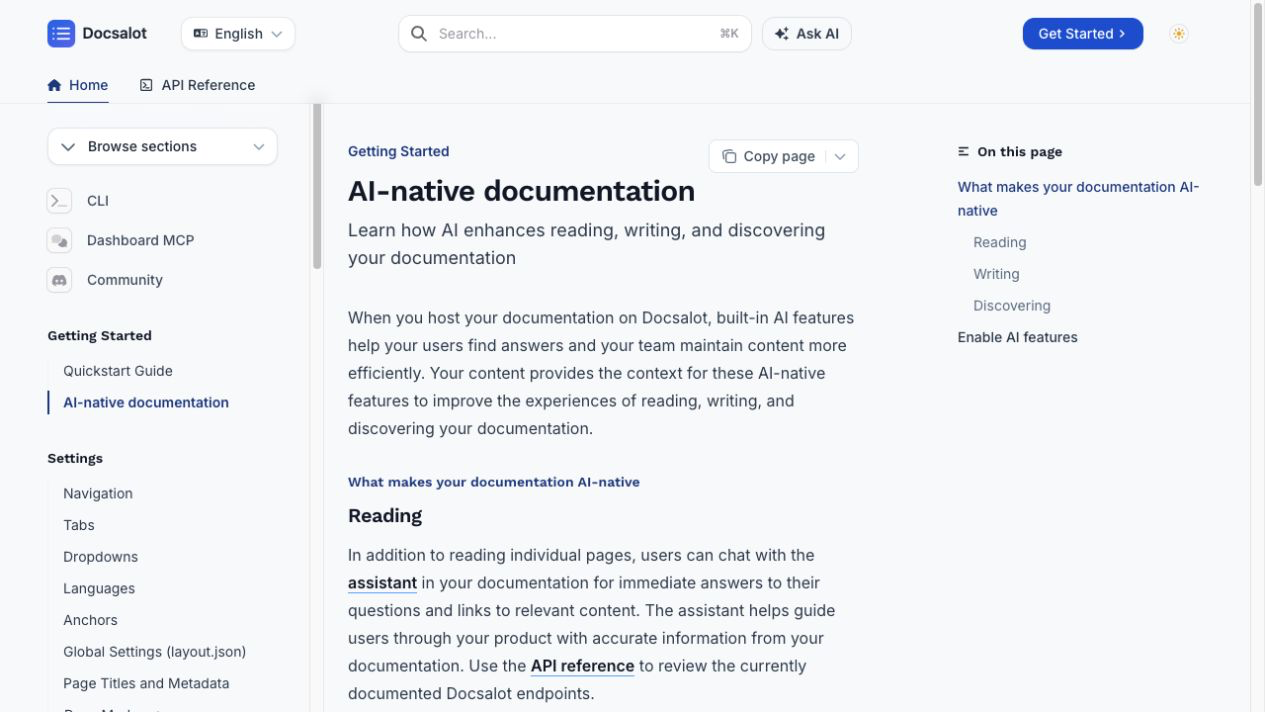
DocsAlot's public documentation separates the category into reading, writing, and discovery. That is more useful than treating “AI” as one feature.
Useful next steps: run DocsAgent Score, inspect the public documentation benchmark, or read how to make documentation AI-readable.
2. Mintlify
Best for: teams that want a polished hosted developer-docs product with strong agent-facing surfaces.
Mintlify now has one of the clearest public definitions of AI-native documentation. It covers reading through its assistant, writing through agents and workflows, and discovery through Markdown, llms.txt, skill.md, semantic search, and hosted MCP.
Its documentation MCP server lets external agents search and fetch published content. A separate authenticated Mintlify MCP can propose page edits, change navigation, update docs.json, and open pull requests. That separation between public retrieval and controlled editing is a good architectural choice.
Choose Mintlify when:
- the team wants polished developer docs without building the frontend
- Git-based review and agent editing should coexist
- hosted MCP and
skill.mdshould work out of the box - a larger paid-plan budget is acceptable
The tradeoff is cost and operating model. Mintlify can automate writing workflows, but the team is still adopting its Git-native documentation product and pricing structure.
Read next: DocsAlot as a Mintlify alternative.
3. GitBook
Best for: organizations that want AI-ready public docs and a mature editor for mixed contributors.
GitBook automatically exposes every published page as Markdown, generates llms.txt and llms-full.txt, and hosts an MCP server for every published space. It also combines Git Sync with a polished block editor, which matters when support, product, and engineering all contribute.
GitBook is a strong AI-native choice when the knowledge system starts with human collaboration. Its AI layer sits on top of a mature content model rather than asking every contributor to work in a repository.
Choose GitBook when:
- visual editing is a first-class requirement
- internal knowledge and public documentation share a workflow
- per-page Markdown and hosted MCP should require no custom build
- the organization already values GitBook's content and permission model
The tradeoff is maintenance ownership. A strong editor and agent-readable output do not automatically mean product changes become reviewed documentation changes. Evaluate the complete update loop, not only the publishing surface.
Read next: DocsAlot as a GitBook alternative.
4. Fern
Best for: API companies where OpenAPI, SDKs, reference docs, and agent access should remain aligned.
Fern's model begins with structured API definitions. It can regenerate API reference pages and SDKs from OpenAPI, AsyncAPI, OpenRPC, gRPC, or Fern definitions. Its published docs expose clean per-page Markdown, generated llms.txt, agent-specific directives, and an MCP server.
Fern also lets authors control what humans and agents receive with llms-only and llms-ignore content. That is a more advanced idea than simply making the same page available as text. A visual instruction can be useful to a human while its CLI equivalent is more useful to an agent.
Choose Fern when:
- API specifications are the canonical source
- SDK generation is part of the documentation system
- agent output needs language or spec filtering to control token use
- authenticated API documentation must be retrievable through MCP
The tradeoff is breadth. Fern is strongest when the API is the product. A broad SaaS help center may need a less spec-centered operating model.
Read next: DocsAlot as a Fern alternative.
5. ReadMe
Best for: interactive API portals where agents and humans both need to inspect and call real endpoints.
ReadMe now supports per-page Markdown, generated or custom llms.txt, a hosted MCP server, WebMCP tools, AI writing, and linting. Its MCP server can expose endpoint listings, schemas, documentation search, and API execution. ReadMe's own authenticated MCP can also search, fetch, create, and update documentation.
That makes ReadMe meaningfully AI-native, especially for API products. Its advantage is not just retrieval. It can connect the documentation to the API itself and preserve the developer-hub experience around keys, logs, and interactive requests.
Choose ReadMe when:
- the documentation is an API developer portal
- endpoint discovery and execution should be available to agents
- personalized developer keys and logs matter
- OpenAPI-backed interactive reference is the core surface
The tradeoff is scope and price. Teams that need broader product documentation or automated upkeep may prefer DocsAlot. Teams that need spec governance may prefer Redocly.
For the wider shortlist, read the best ReadMe alternatives in 2026.
6. Redocly Realm
Best for: enterprise API programs that need AI-ready delivery inside a governed OpenAPI system.
Redocly Realm serves Markdown and llms.txt, supports agent skills, and can expose documentation and OpenAPI descriptions through MCP. Its MCP implementation respects project access controls and can expose selected API operations as tools.
The larger reason to choose Redocly is governance. AI retrieval sits beside API catalogs, linting, scorecards, role-based access, and enterprise portal controls. That is valuable when the primary risk is inconsistency across many APIs rather than one stale getting-started guide.
Choose Redocly when:
- OpenAPI governance is already an organizational requirement
- private API docs need controlled agent access
- MCP tools must map carefully to approved operations
- catalogs and scorecards belong in the same system
The tradeoff is weight. This is a substantial API-platform decision, not the easiest way to publish a small documentation site.
Read next: DocsAlot as a Redocly alternative.
7. Fumadocs
Best for: Next.js teams that want to build and own an AI-readable docs stack.
Fumadocs is the actual framework in this list. It can generate llms.txt, llms-full.txt, and per-page Markdown routes. It provides UI patterns for AI search, but deliberately leaves the model and much of the retrieval architecture to the implementer.
That is a strength when control is the requirement. The team can choose the model, retrieval system, hosting, observability, and security boundary. It is also the cost: Fumadocs gives you components and conventions, not a managed documentation operation.
Choose Fumadocs when:
- Next.js is already the product stack
- custom UI and retrieval behavior matter
- the team wants open-source control
- engineers are willing to own hosting, search, updates, and evaluation
The tradeoff is simple: the framework can make AI-native delivery possible, but it does not make the whole system happen automatically.
Read next: DocsAlot as a Fumadocs alternative.
What Does Not Make Documentation AI-Native?
These are useful features, but none is sufficient by itself:
- An AI chat widget: It can answer from stale content just as efficiently as a person can read it.
- An AI writer: Drafting faster does not connect the draft to product truth.
- An
llms.txtfile: It is a discovery index, not a maintenance workflow or task specification. - An MCP endpoint: A protocol does not guarantee useful tool descriptions, correct permissions, fresh content, or good retrieval.
- Semantic search: Better ranking does not fix missing examples or obsolete instructions.
- More generated pages: Volume is not quality, and duplicated text can make retrieval worse.
The category becomes meaningful only when these pieces form a controlled loop.
How to Evaluate an AI-Native Documentation System
Run a small proof instead of a feature demo.
- Pick three real user tasks, including one with authentication and one failure path.
- Ask both a person and an agent to complete them from the published docs.
- Record every page, tool, and example each one used.
- Change one relevant API field or product behavior.
- Measure how quickly the docs system detects the affected content.
- Review the proposed change for source evidence and false assumptions.
- Publish it and repeat the original tasks.
Measure task completion, retrieval accuracy, unsupported claims, time to reviewed update, and the percentage of answers that cite the canonical page.
This is also why we built the public DocsAgent Score and documentation benchmark. A generated file is evidence that a feature exists. A successful task is evidence that the documentation works.
Which AI-Native Documentation Framework Should You Choose?
- Choose DocsAlot for managed upkeep across API, product, and onboarding docs.
- Choose Mintlify for polished Git-native developer docs with strong agent integrations.
- Choose GitBook for mixed contributors and mature visual editing.
- Choose Fern when the API spec and SDKs are the center of truth.
- Choose ReadMe for interactive, personalized API developer hubs.
- Choose Redocly Realm for governed enterprise API programs.
- Choose Fumadocs when your Next.js team wants to own the entire stack.
The useful question is not “Which vendor has the most AI?” It is “Which parts of the documentation loop do we want to own?”
FAQ
What is AI-native documentation?
AI-native documentation is designed for humans and software agents across delivery, retrieval, maintenance, permissions, and evaluation. It exposes structured content to agents, connects product changes to reviewed documentation changes, and preserves a canonical source of truth.
Is llms.txt enough to make documentation AI-native?
No. llms.txt helps agents discover pages. It does not provide task instructions, detect stale content, enforce permissions, review generated changes, or measure whether an agent completed the user's task.
What is the difference between AI-readable and AI-native documentation?
AI-readable documentation is easy for models to fetch and parse, usually through Markdown, llms.txt, or MCP. AI-native documentation also changes how the content is maintained, reviewed, secured, and evaluated.
Do AI-native docs still need human writers?
Yes. AI can find affected pages, draft changes, normalize examples, and reduce repetitive work. Humans still decide what is true, what should be public, how a concept should be taught, and whether a proposed change is safe to publish.
Which open-source framework is best for AI-native docs?
Fumadocs is the strongest option in this list for a Next.js team that wants built-in patterns for llms.txt, Markdown endpoints, and bring-your-own AI search. Docusaurus can also be extended, but more of the AI-facing delivery and retrieval layer must be assembled separately.
Sources Checked
- DocsAlot AI-readable documentation
- Mintlify AI-native documentation
- Mintlify documentation MCP
- GitBook LLM-ready docs
- Fern documentation for developers and agents
- Fern llms.txt
- Fern MCP server
- ReadMe AI discoverability
- ReadMe MCP server
- Redocly AI-ready documentation
- Redocly MCP server
- Fumadocs AI and LLM integrations