Head-to-head research
Fumadocs vs Starlight: Design, Components, and Docs Ownership
Two excellent open-source documentation frameworks with different frontend philosophies: React composition in Fumadocs versus accessible Astro defaults in Starlight.
Choose Fumadocs when your team wants a highly composable React and Next.js documentation stack with deeper component flexibility. Choose Starlight when you want a beautifully designed, accessible Astro documentation foundation with fewer decisions before the first polished page. Choose DocsAlot when the team wants strong design but does not want to own hosting, framework upgrades, search, and agent-facing delivery.
Related research: Fumadocs alternative, Starlight alternative.
Mobile Lighthouse
Page-load speed comparison
Starlight led the tested pages, followed by Fumadocs and DocsAlot.
- #1 Starlight
100 / 100
Starlight getting started, Oct 18; median of 98, 100, 100
- #2 Fumadocs
96 / 100
Fumadocs docs, Oct 28; three-run median
View Fumadocs report - #3 DocsAlot
82 / 100
Backboard docs on DocsAlot, Oct 15; three-run median
View DocsAlot report
These are lab scores for different pages, dates, and test setups, not a controlled head-to-head. The numbers describe the pages tested, not what every site will score.
Published product evidence
See the products before you compare the checklists.
These are current public product or documentation surfaces, not reconstructed mockups. Open the live pages to evaluate information hierarchy, navigation, and reading experience yourself.
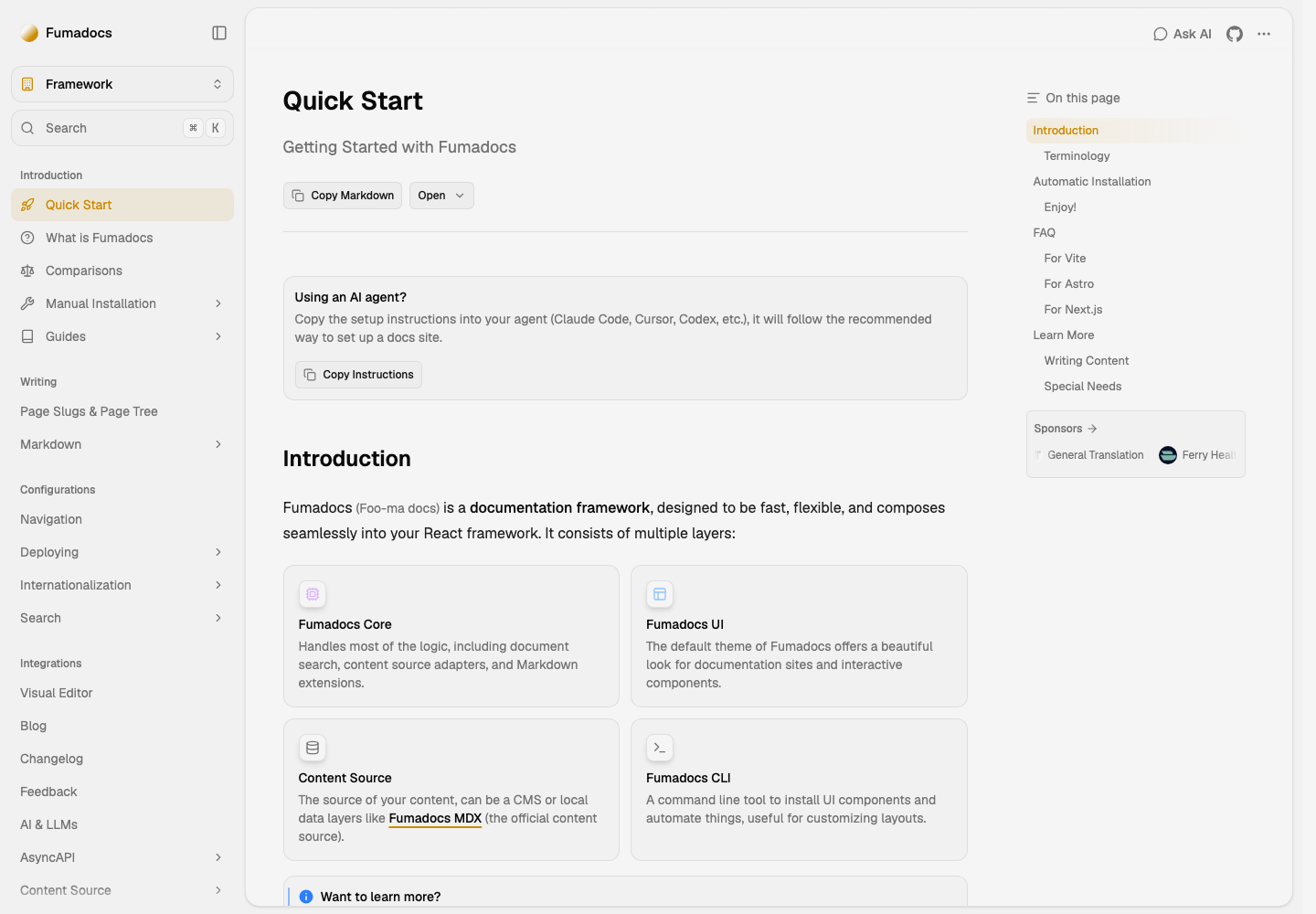
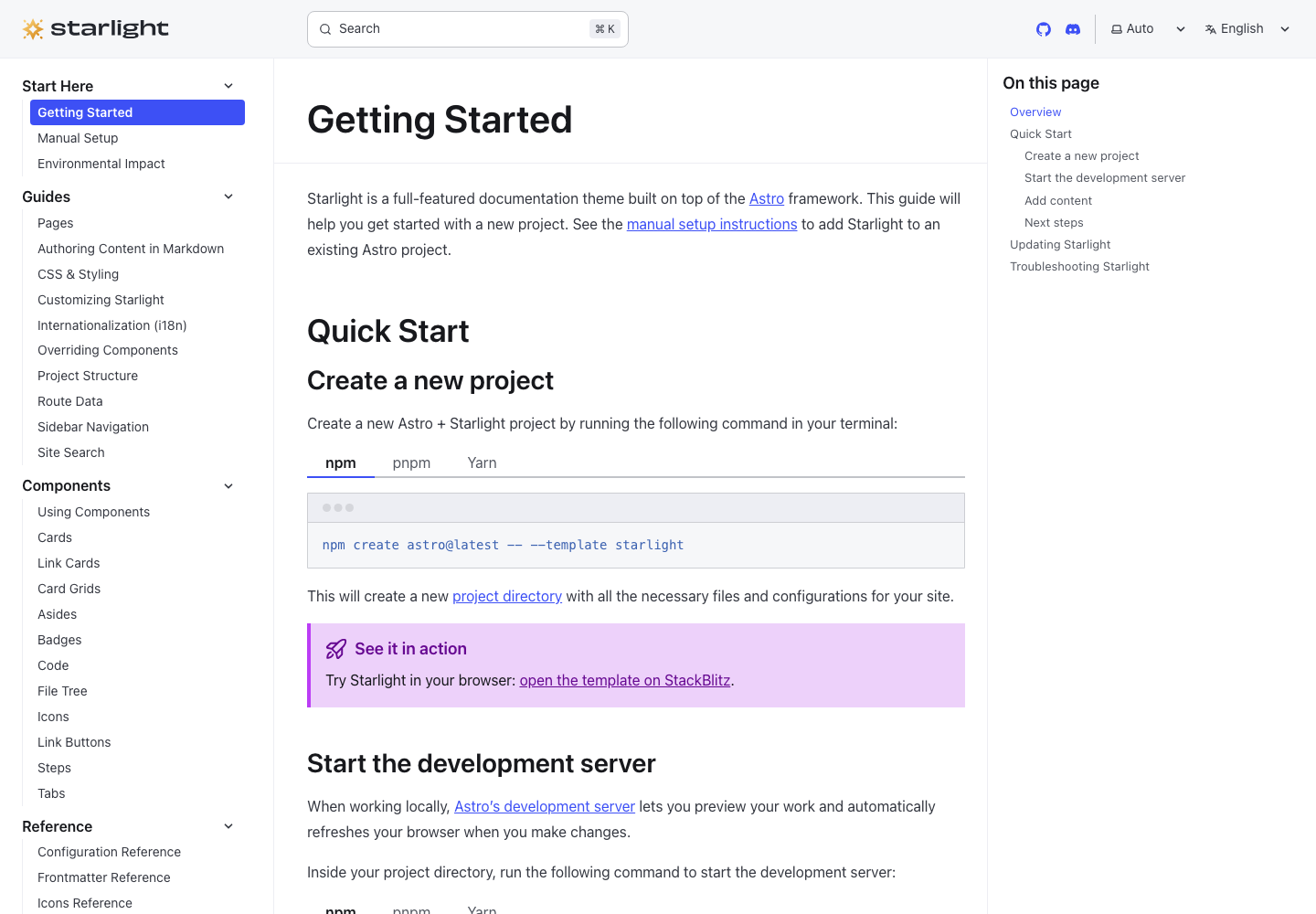
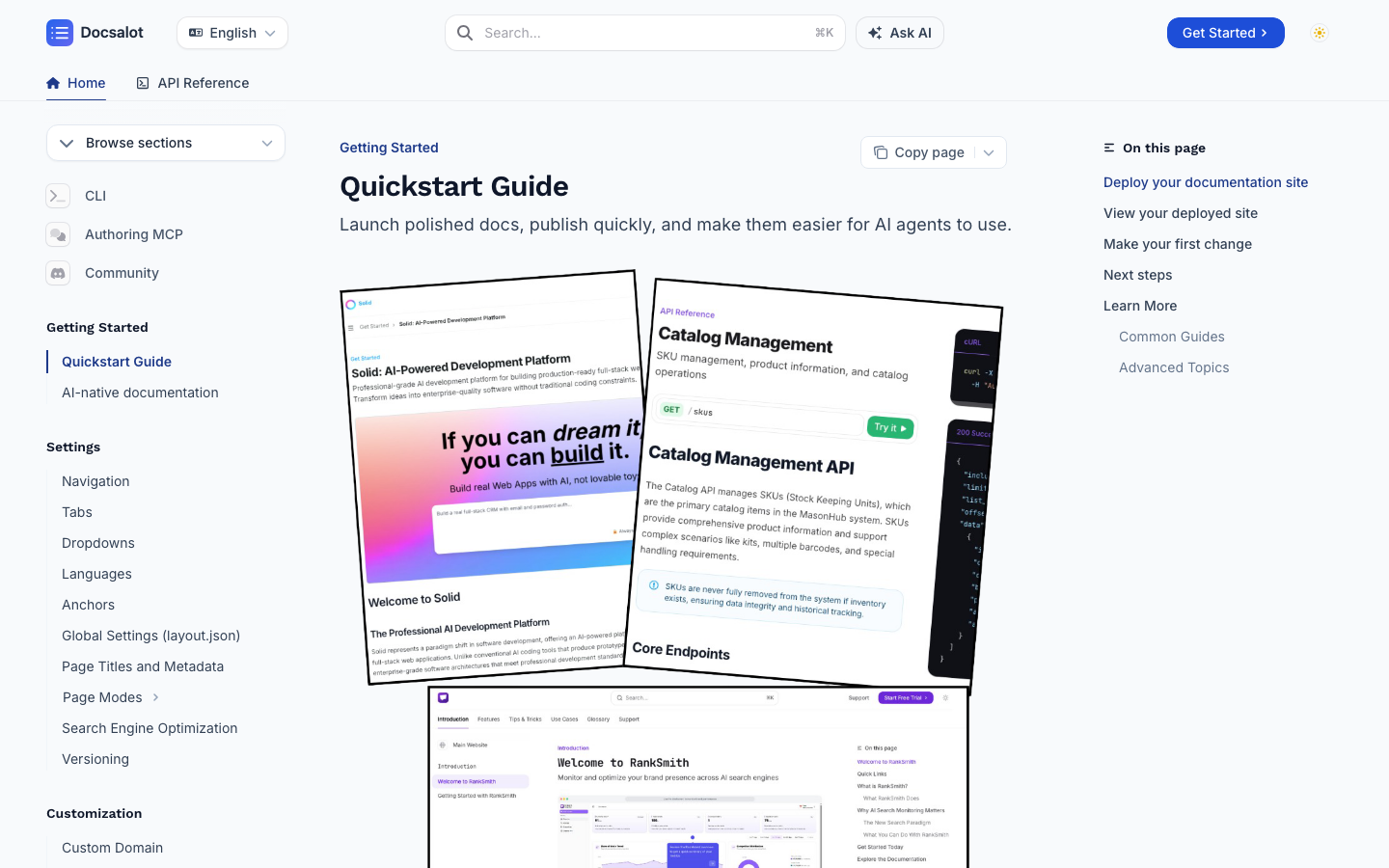
Product interfaces change over time. Use the live links above for the current evaluation.
Side-by-side matrix
Fumadocs vs Starlight: the decisions that actually change the implementation.
The table leads because framework, design system, component depth, and operational ownership matter more here than a long list of overlapping documentation features.
Swipe sideways on mobile to view the full matrix.
| Dimension | Fumadocs | Starlight | DocsAlot | Takeaway |
|---|---|---|---|---|
| Starting price | $0 software license You deploy and maintain the site. Free hosting can work for small sites; budget roughly $50 to $100/month if you need paid hosting and related services, before engineering time. This is a planning estimate, not a vendor fee. | $0 software license You deploy and maintain the site. Free hosting can work for small sites; budget roughly $50 to $100/month if you need paid hosting and related services, before engineering time. This is a planning estimate, not a vendor fee. | $79 / month Startup includes one managed public docs site, search, a visual editor, and agent-readable docs. See plan details for custom domains and private docs. | Compare plan limits and operating costs, not just the entry price. |
| Page-load speed comparison | 96/100 Fumadocs docs, Oct 28; three-run median. Report | 100/100 Starlight getting started, Oct 18; median of 98, 100, 100 | 82/100 Backboard docs on DocsAlot, Oct 15; three-run median. Report | Starlight > Fumadocs > DocsAlot in these samples. |
| AI-native benchmarks | First-party integrations Markdown, llms.txt, and MCP routes are available; you configure and deploy them. Docs | Community integrations Add Markdown, llms.txt, and MCP separately with plugins or integrations. Docs | Managed outputs Markdown, llms.txt, and hosted MCP Docs | Choose DocsAlot for managed delivery. Frameworks give you control over the setup and hosting. |
| Core stack | React / Next.js | Astro | Hosted docs-as-code with a visual editor | Choose the framework your frontend team already wants to own. |
| Published design | Polished and highly composable | Polished and opinionated | Responsive reader layouts with custom branding | Both look strong. Fumadocs offers a higher custom ceiling; Starlight reaches a cohesive default sooner. |
| Custom components | Deeper React component system | Astro and MDX components | Reusable docs components and custom styling | Fumadocs when complex interactive documentation components are central to the product. |
| Accessibility defaults | Strong, implementation-dependent | Excellent built-in baseline | Responsive navigation, page outline, and searchable content | Starlight when accessible defaults should reduce the amount of frontend tuning required. |
| Search and navigation | Framework primitives and integrations | Documentation defaults and integrations | Built-in search, sidebar, and page outline | Starlight starts more opinionated; Fumadocs gives the team more room to compose the experience. |
| Hosting and deployment | Self-deployed | Self-deployed | Managed hosting and publishing | Tie. Both leave production infrastructure and operations with your team. |
| Best fit | React teams building a custom docs application | Astro teams wanting excellent docs defaults | Teams that want polished docs without operating a framework | Fumadocs for composition depth; Starlight for a strong accessible baseline with fewer design decisions. |
Speed shows mobile Lighthouse performance scores for different pages, dates, and test setups. These snapshots are directional, not a controlled platform test. The AI-native benchmark checks whether Markdown, llms.txt, and MCP are managed or require setup; it does not measure AI answer quality.
Key differences
Where Fumadocs and Starlight make different tradeoffs.
Both can produce excellent docs. The meaningful split is how much composition freedom, accessible structure, and long-term application ownership the team wants.
React composition versus Astro defaults
Fumadocs gives React and Next.js teams deeper composition and component control. Starlight gives Astro teams a more opinionated, accessible documentation experience with excellent design defaults.
Design flexibility
Both can produce beautiful documentation, but Fumadocs has the higher ceiling for teams that want to build richer custom components and treat the docs site as a React application.
Accessible documentation defaults
Starlight starts closer to a complete, accessible documentation shell. Fumadocs remains highly capable, but its composability asks the team to make more product and implementation decisions.
Operational ownership
Both are frameworks rather than managed documentation products. Your team still owns hosting, deployments, search choices, upgrades, integrations, and the production support burden.
Shortlist guidance
Which teams usually choose each framework.
Use the existing frontend stack and the team's appetite for ongoing docs engineering as the shortlist filter.
Fumadocs
Choose Fumadocs if you need:
- a React and Next.js documentation stack that fits the rest of your frontend architecture
- richer custom components and deeper control over the documentation application
- a framework your engineers are comfortable extending as product requirements grow
Starlight
Choose Starlight if you need:
- excellent design and accessibility defaults without starting from a blank page
- an Astro-native documentation framework with a cohesive information architecture
- a polished static documentation experience with fewer initial frontend decisions
Bottom line
The framework is free; ownership is the purchase.
Fumadocs and Starlight are both excellent framework choices. The decision is React composition depth versus Astro's cohesive documentation defaults. If the real problem is the engineering time required to run either framework in production, compare both against a managed DocsAlot migration rather than debating themes indefinitely.- Prototype one representative guide with code samples, callouts, and a custom component in both frameworks.
- Test keyboard navigation, mobile layout, search, and deployment rather than comparing desktop screenshots alone.
- Estimate the engineering hours required for upgrades, plugins, agent outputs, and production regressions over the next year.
Common comparison questions
Fumadocs vs Starlight migration questions
These are the search and shortlist questions that usually come up when the same comparison is framed from the other side.
Is Fumadocs better designed than Starlight?
Not categorically. Fumadocs offers a higher ceiling for custom React composition, while Starlight provides a more cohesive accessible design baseline with fewer decisions before launch.
Which is easier to maintain, Fumadocs or Starlight?
That depends mainly on whether your team is stronger in React and Next.js or Astro. Both still require your team to own deployment, upgrades, integrations, and production behavior.
Can we migrate from either framework without losing SEO?
Yes, if the migration preserves the domain and valuable paths, maps redirects for necessary changes, and carries over metadata, canonicals, and the sitemap. A parallel private draft makes those checks possible before cutover.
Related research
Keep the research moving without restarting from scratch.
If the category boundary is still moving, the next useful pages are usually adjacent head-to-head matchups in the same research track.