ReadMe Alternative
DocsAlot vs ReadMe
A direct comparison for teams choosing between ReadMe's mature API-docs workflow and DocsAlot's lower-cost automation-first documentation system.
Read this when the shortlist is already down to serious API-docs vendors. ReadMe is strong on mature API-docs workflows. DocsAlot wins when you want comparable practical coverage, automated updates, and a calmer fixed-price documentation system.
Private migration preview
See your ReadMe docs hosted by DocsAlot.
No DNS changes, no downtime, and no public launch. Your current site stays live while you review the editable hosted draft.
Comparing a wider shortlist? Read the best ReadMe alternatives.
Published design
Compare both published experiences.
ReadMe has a real product and design advantage for the teams it serves. Compare the current public experience with DocsAlot, then use the workflow, pricing, and fit sections below for the buying decision.
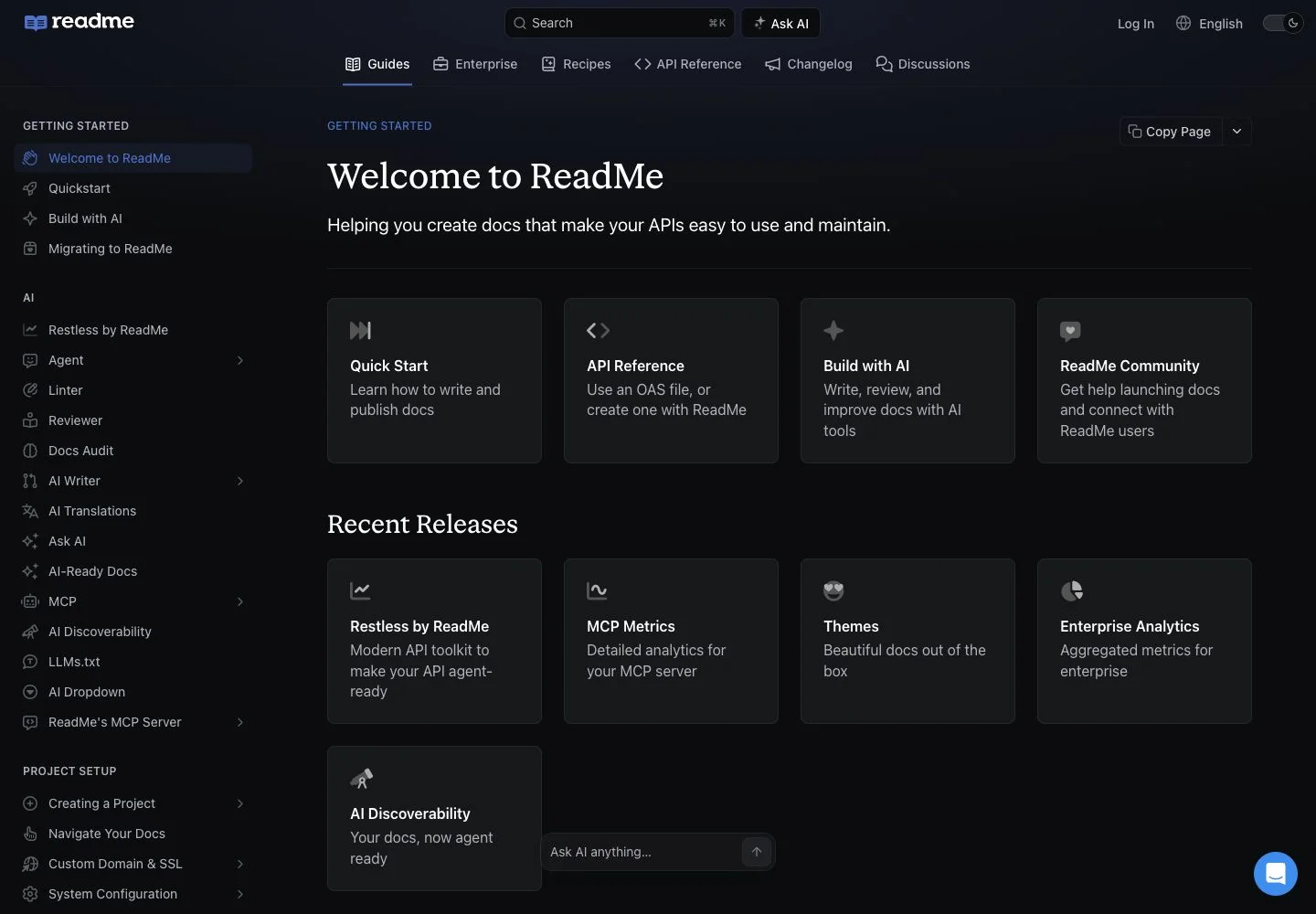
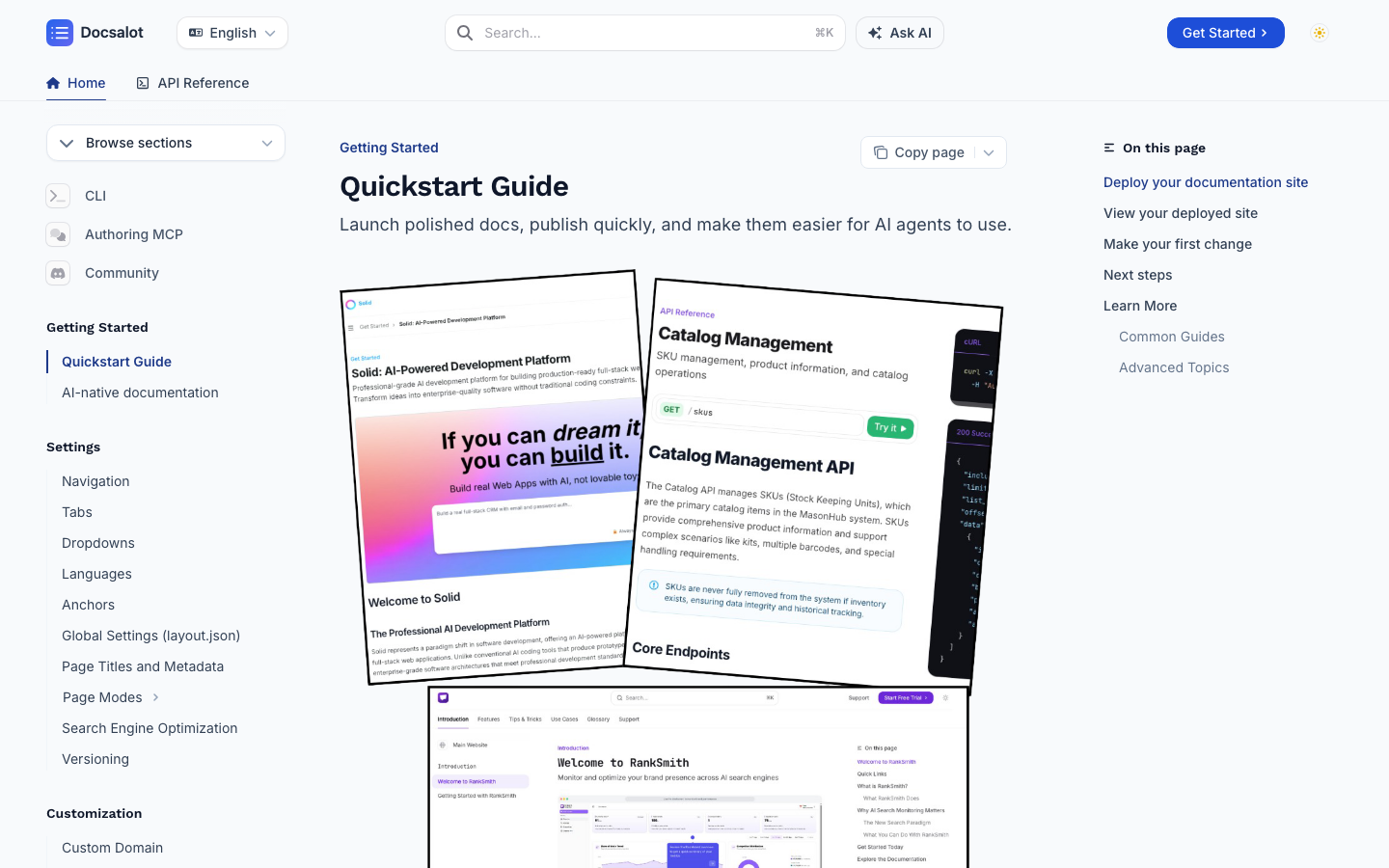
Competitor screenshot captured November 20, 2026. Product interfaces change, so use the live links above for the current evaluation.
Starting price
What it costs to get started.
Entry prices are in USD. Compare what is included, not just the number.
Startup includes one managed public docs site, search, a visual editor, and agent-readable docs. See plan details for custom domains and private docs.
Starter covers basic hosted API documentation. Advanced developer-hub features are paid.
Workflow comparison
Compare what your team gets.
Swipe sideways on mobile to view the full matrix.
| Dimension | DocsAlot | ReadMe | Takeaway |
|---|---|---|---|
| Developer portal polish | Strong | Stronger | ReadMe if the primary requirement is a polished hosted developer portal experience. |
| API reference depth | Good | Strong | ReadMe if the shortlist is mostly about API reference and developer-hub UX. |
| Broader docs surface | Broader | Good | DocsAlot if the same system must cover onboarding, product docs, and support content too. |
| Git-backed workflow | Strong | Strong | Tie on workflow model; the decision is more about scope and upkeep. |
| AI role in the workflow | Automation-first | Tooling + add-ons | DocsAlot if AI should reduce maintenance overhead rather than sit beside a manual docs workflow. |
| Manual maintenance burden | Lower | Higher | DocsAlot when the team wants less ongoing documentation ownership. |
| Hosted docs-as-product ergonomics | Good | Strong | ReadMe if hosted docs-as-product tooling is the main purchase. |
This matrix is intentionally dense because these pages are meant to answer buying questions, not just act as thin keyword landing pages.
Long-form read
What this comparison means in practice.
Read this as the operating-model summary: ReadMe is a polished hosted API-docs hub, while DocsAlot is the lower-cost automation-first docs workflow.
ReadMe and DocsAlot overlap on more of the visible surface than older alternative pages usually admit. ReadMe already covers API docs, guides, changelogs, Git-backed workflows, reusable content, and hosted developer-portal presentation. That means the real comparison is not whether ReadMe is modern enough. It is whether the company wants a developer hub centered on hosted portal experience, or a broader documentation workflow that asks the team to own less long-term upkeep.
ReadMe is strongest when the portal itself is a major part of the product decision. If the team is optimizing for hosted developer-hub polish, interactive API reference, portal analytics, and an API-program-style experience, ReadMe remains a strong choice. It makes the most sense when API reference quality and developer-hub presentation sit at the center of the buying process rather than the broader documentation operation around them.
DocsAlot is stronger when the documentation system has to do more than act as a polished developer portal. If the company also needs automated updates, AI-readable outputs, hosted MCP access, onboarding, product education, support-facing technical content, and agents that can use the website and dashboard as source context, DocsAlot becomes the better fit. The main value is not that it adds a portal checkbox. It is that it uses automation to reduce the recurring maintenance burden behind a larger docs program while still giving the team mature API and developer docs.
Migration path
Test a move from ReadMe without risking search traffic.
Keep the current site live while you review a private DocsAlot draft. Switch only after the content, design, routes, and redirects have earned approval.
- Start with the live docs. Submit the current public URL so the first draft begins with real content and navigation instead of an empty workspace.
- Review a private preview. Check page structure, code examples, assets, search, responsive behavior, and the published design while the existing site remains untouched.
- Keep the source model that works. Connect the repository when Git should remain canonical, then use pull requests, coding agents, or the browser editor without rebuilding the publishing stack.
- Preserve URLs before DNS changes. Keep the existing domain and page paths wherever possible, then create one-to-one redirects for every route that must change.
- Cut over only after approval. Change the domain when the replacement is ready, submit the sitemap, and monitor indexing, clicks, redirects, and crawl errors after launch.
The evaluation is reversible: your current ReadMe site stays live until the DocsAlot version is ready. Preserve the same domain and routes and search engines continue to resolve the same URLs; only the publishing layer changes.
Product shape
What each product is optimized to do.
Two tools can overlap on outputs while still being built for very different documentation jobs. This is the higher-level operating-model read.
ReadMe
What ReadMe optimizes for.
ReadMe positions itself as the full documentation stack for teams that want API docs, guides, changelogs, Git-backed workflows, reusable content, and a polished developer portal in one hosted product.
DocsAlot
What DocsAlot optimizes for.
DocsAlot is strongest when a lean software team wants technical docs that stay current with less manual upkeep and a broader surface area than only API reference pages.
FAQs
Questions that usually block the switch.
These are usually the questions that slow internal alignment, migration planning, or procurement once the shortlist is already real.
Is ReadMe a real direct competitor?
Yes. ReadMe is one of the more serious hosted developer-doc competitors because it spans API docs, guides, changelogs, and a polished developer portal.
When does ReadMe make more sense than DocsAlot?
ReadMe makes more sense when the buying decision is centered on hosted developer-portal polish, API reference quality, and docs-as-product ergonomics more than on reducing maintenance overhead.
Can we migrate from ReadMe without losing everything?
Usually yes. ReadMe already supports Git-based content and import workflows, so the migration problem is more about content mapping and URL planning than starting from zero.
Is ReadMe better for API-only companies?
Often yes, especially if API reference and developer adoption are the center of the product experience. The comparison shifts once the docs program needs to cover more than the developer portal alone.
How should I think about the AI difference?
ReadMe has meaningful AI tooling, but the DocsAlot argument is more specific: use AI to reduce writing and upkeep work rather than just adding more portal features around a manual docs workflow.
What usually causes the switch away from ReadMe?
Usually not that ReadMe is weak. The switch happens when the broader docs program outgrows an API-first portal model or when maintenance burden becomes more painful than portal polish is valuable.
Customer proof
What teams say after publishing with DocsAlot.
These are DocsAlot customers and live documentation sites. They are product proof, not a claim that every customer migrated from ReadMe.
"Fantastic stuff! The introduction perfectly nails the Mako Code's idea. I particularly enjoyed the Technical Deep Dive with its explained code snippets, and the Project Architecture's file tree was both cool and useful."
"I don't know what you did, but it's amazing. Just having our docs on DocsAlot gave us an uptick in SEO, the page-load speed is super fast, and auto-sync is a game changer."
"We were looking into Mintlify/GitBook for our docs, but were disappointed. Super expensive ($300) for the value they were offering. Switched to DocsAlot and couldn't be happier."
Try the workflow
Ready to test whether DocsAlot fits your documentation stack?
Use your current ReadMe docs as the starting point. DocsAlot will carry the public URL into onboarding so you can generate and review an editable migration draft.