Head-to-head research
Apidog vs Stainless
A developer-experience comparison for teams evaluating docs, API programs, SDK generation, and developer onboarding together.
Apidog is the better fit when an all-in-one API suite is the main objective. Stainless is strongest when SDK maturity is the center of the buy. Use this page to decide which operating model actually belongs on the shortlist before treating these tools as direct substitutes.
If the real question is category fit, see API docs automation, AI-readable documentation, and our API to CLI and SDK generator.
Key differences
Where Apidog and Stainless usually split.
The useful differences are product shape, source of truth, and how much of the workflow each tool is trying to own over time.
Where Apidog usually pulls ahead
Apidog is the better fit when an all-in-one API suite is the main objective.
Where Stainless usually pulls ahead
Stainless is strongest when SDK maturity is the center of the buy.
Ownership and operating model
Apidog and Stainless are not just feature choices. They ask the team to run documentation and support work in materially different ways over time.
What usually decides the shortlist
The final decision is usually less about headline feature overlap and more about where the source of truth lives, what gets generated automatically, and how much ongoing upkeep the team is willing to own.
Side-by-side matrix
Apidog vs Stainless on workflow, pricing, and developer-facing outputs.
Read the matrix as an operating-model comparison, not a checklist race. The important question is what kind of system the team actually wants to buy and run.
Swipe sideways on mobile to view the full matrix.
| Dimension | Apidog | Stainless | Takeaway |
|---|---|---|---|
| Starting price | $0 starting plan The free plan has team and project limits. Check the tier for your publishing and collaboration needs. | $0 starting plan Free generation is limited; paid plans cover additional SDK needs. | Compare plan limits and operating costs, not just the entry price. |
| Product shape | hosted developer-docs platform | SDK, CLI, or API generation platform | The more useful page is the one that reflects how the team actually wants to run docs, not just which tool has more boxes checked. |
| Hosting / ownership | Managed SaaS | Managed SaaS | Ownership style is often the fastest way to eliminate the wrong shortlist option. |
| AI / agent readiness | Limited out of the box | Explicit AI / agent layer | If agents need to read the docs reliably, compare delivery model and machine-readability, not just whether the UI has AI features. |
| Source workflow | Managed workflow | Managed workflow | This is usually the real day-to-day adoption boundary after the first launch. |
| Best-fit job | Apidog is built for API teams that want one suite for design, debugging, mocking, testing, docs, and collaboration | Stainless is a generator platform for SDKs, docs, CLIs, and MCP servers driven from the API spec | Keep the tool whose core job still matches the documentation program after the hype is stripped away. |
| Ongoing upkeep | Lighter managed upkeep | Lighter managed upkeep | This matters more than feature-count once releases, support changes, and onboarding content all start moving in parallel. |
This matrix is meant to narrow the shortlist by revealing which operating model fits the team better in practice.
Shortlist guidance
Which teams usually choose Apidog or Stainless.
These buying patterns tend to decide the shortlist once both products look viable on the surface.
Apidog
Choose Apidog if you need:
- You want one API suite: The team prefers to keep design, testing, and docs in the same API platform.
- API design and testing are ahead of docs concerns: Documentation is important, but not the only or primary buying requirement.
- Consolidating API workflow tools is the real project: Apidog makes the most sense when replacing a scattered API toolchain matters more than building the strongest standalone docs system.
Stainless
Choose Stainless if you need:
- Generated SDKs are the priority: The team is buying a spec-first artifact pipeline before it is buying a broader documentation system.
- Generated docs and MCP servers are part of the buy: Your API company wants multiple generated developer outputs from one platform rather than a broader docs workflow.
- You are buying an API-company platform: Stainless makes the most sense when generator quality and spec-first output are the real product priorities.
A managed third path
Put the generated API assets inside a maintained docs product.
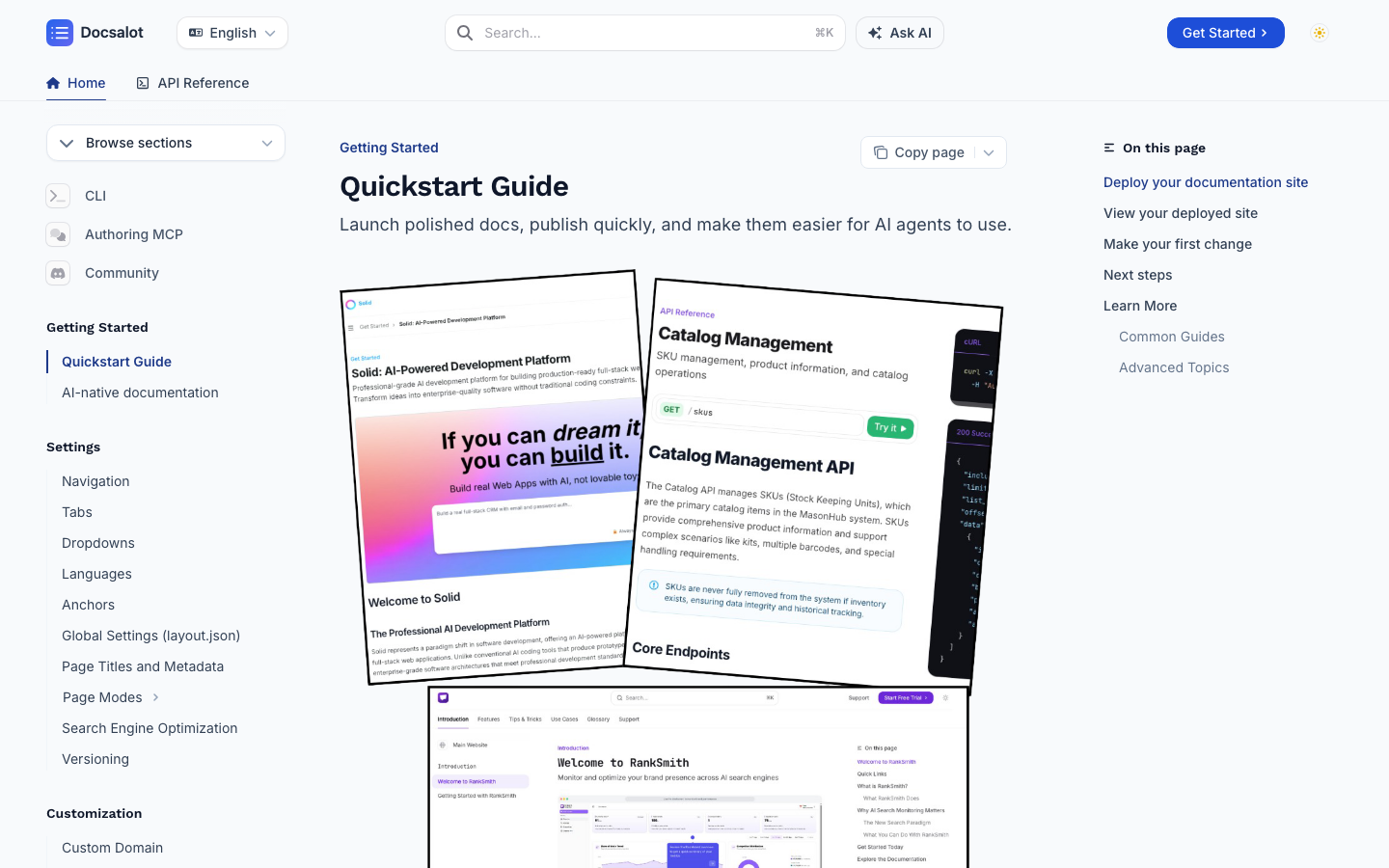
DocsAlot belongs on the shortlist when SDKs, CLIs, API references, and product guides should live in one hosted system for people and coding agents.
$79 / month for managed public docs.
Fast published pages: Backboard's DocsAlot-hosted docs scored 82/100 on mobile Lighthouse with 40 ms of total blocking time. See the October 15 report. Median of three simulated cold-cache runs on one site, not a head-to-head test.
Where DocsAlot fits
- Documentation quality is the real bottleneck: The team is less concerned with consolidating API tools and more concerned with publishing better docs across the product surface.
- The docs audience is broader than API builders: The same system needs to support onboarding, support, evaluation, and product education rather than only API development workflows.
- You want a lower-maintenance docs operating model: The core problem is keeping the documentation estate current, not only managing API design and test workflows in one suite.
- You want a documentation purchase, not a full API-suite purchase: The team wants the spend to go toward the docs layer instead of inheriting broader API-platform pricing and complexity.
Bottom line
What usually decides Apidog vs Stainless.
Apidog is a better fit when the team really wants a hosted developer-docs platform. Stainless is a better fit when the team really wants a SDK, CLI, or API generation platform. If both still look credible after that distinction, the next move is to inspect the live product surface, generated outputs, and real pricing shape rather than reading more generic feature tables.- Check whether Apidog or Stainless still matches the team’s real operating model after the feature overlap is stripped away.
- Pressure-test pricing against actual collaborators, outputs, and rollout scope rather than reading sticker price in isolation.
- Look at the live product surface and generated outputs before finalizing the shortlist.
Related research
Keep the research moving without restarting from scratch.
If the category boundary is still moving, the next useful pages are usually adjacent head-to-head matchups in the same research track.