Head-to-head research
Apidog vs Fern
All-in-one API workspace versus a spec-first SDK and docs platform.
Apidog is broader across API design, debugging, mocking, testing, and documentation inside one workspace. Fern is narrower but deeper around spec-first SDK generation, code samples, and developer onboarding assets. The real decision is whether the team wants one API suite or a generation-first platform anchored to the spec.
If the real question is category fit, see API docs automation, AI-readable documentation, and our API to CLI and SDK generator.
Key differences
Where Apidog and Fern usually split.
This comparison is more useful when you read it as a product-shape decision. One side wants to own more of the API workspace, while the other wants to own more of the generated developer experience.
Platform breadth
Apidog is the broader API workspace. It is designed to keep design, debugging, mocking, testing, collaboration, and published docs in one product.
Generated SDK depth
Fern is stronger when the buying requirement is generated SDK quality, code samples, and a spec-first pipeline that turns the contract into developer-facing assets.
Where documentation sits in the stack
With Fern, docs are downstream of the spec and tightly coupled to the generated developer experience. With Apidog, docs are one part of a larger API workspace.
Budget shape
Apidog usually makes more sense when the team wants one broader platform with lower entry pricing. Fern becomes easier to justify when per-SDK pricing is acceptable because generated artifacts are central to the product strategy.
Side-by-side matrix
Apidog vs Fern on workflow, pricing, and developer-facing outputs.
The important comparison is not whether both products can publish docs. It is whether the team needs API suite breadth or a tighter spec-first delivery model for SDKs and developer onboarding assets.
Swipe sideways on mobile to view the full matrix.
| Dimension | Apidog | Fern | Takeaway |
|---|---|---|---|
| Starting price | $0 starting plan The free plan has team and project limits. Check the tier for your publishing and collaboration needs. | $0 starting plan The free Docs plan limits pages, page generations, and AI credits. SDKs are priced separately. | Compare plan limits and operating costs, not just the entry price. |
| Product center of gravity | API workspace | SDK + docs generation platform | This is the real split. Apidog starts with lifecycle breadth. Fern starts with spec-first delivery of developer-facing artifacts. |
| Design, debugging, and testing | Stronger | Secondary | Apidog is stronger if the team wants the suite to own more of the API workflow before the docs are published. |
| Generated SDK depth | Light | Stronger | Fern is stronger when generated SDK quality is a first-order buying requirement rather than a nice-to-have. |
| Source of truth | Shared API workspace | Spec-first pipeline | Choose based on whether the team wants a collaborative API console or a contract-centered generation layer. |
| Docs in the workflow | One module inside the suite | One output of the generation system | Both support docs, but they place documentation in different parts of the stack. That difference matters more than headline feature overlap. |
| Best-fit buyer | Teams consolidating API tools | API companies prioritizing generated developer artifacts | If the roadmap is about fewer API tools, Apidog fits better. If it is about SDK quality and spec-first delivery, Fern fits better. |
This matrix is meant to narrow the shortlist by revealing which operating model fits the team better in practice.
Shortlist guidance
Which teams usually choose Apidog or Fern.
These buying patterns tend to decide the shortlist once both products look credible on API docs alone.
Apidog
Choose Apidog if you need:
- one place for design, debugging, mocking, testing, and docs
- an API workspace that multiple collaborators can use day to day
- lower entry pricing than a per-SDK generation model
- toolchain consolidation to matter more than SDK depth
Fern
Choose Fern if you need:
- generated SDKs to be central to the purchase
- a spec-first workflow that produces docs, code samples, and clients together
- developer onboarding assets to stay tightly coupled to the contract
- a platform optimized for API-company delivery rather than broader API suite breadth
A managed third path
Put the generated API assets inside a maintained docs product.
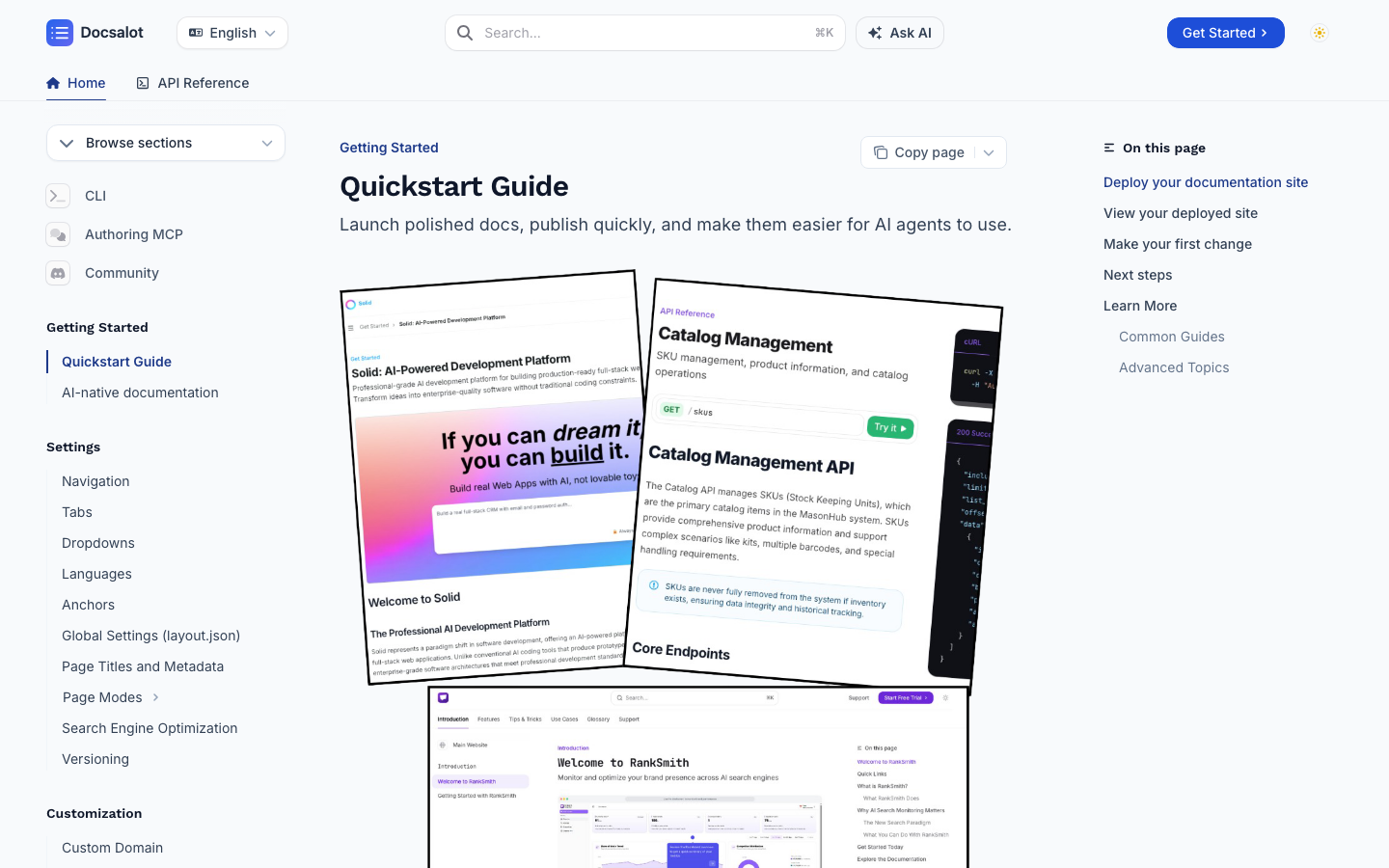
DocsAlot belongs on the shortlist when SDKs, CLIs, API references, and product guides should live in one hosted system for people and coding agents.
$79 / month for managed public docs.
Fast published pages: Backboard's DocsAlot-hosted docs scored 82/100 on mobile Lighthouse with 40 ms of total blocking time. See the October 15 report. Median of three simulated cold-cache runs on one site, not a head-to-head test.
Where DocsAlot fits
- You want polished hosted docs without owning another deployment and maintenance surface.
- You need Git-backed authoring plus clean Markdown, llms.txt, skills, and hosted MCP for agents.
- You want migration help and a predictable path from the current docs into a private working draft.
Bottom line
What usually decides this comparison.
Choose Apidog if the project is really about consolidating API design, testing, mocking, and docs into one shared workspace. Choose Fern if the real buy is a spec-first generation layer that turns the contract into SDKs, code samples, and developer-facing docs. Teams that only compare them as 'API docs tools' usually miss the point.- Look at the generated SDKs, code samples, and live reference experience before assuming both products are equivalent on developer onboarding.
- Pressure-test pricing against the actual number of collaborators, APIs, and SDKs you expect to support in the next 12 months.
- Decide whether the source of truth should live in a collaborative API workspace or in a contract-first generation pipeline.
Related API DX research
Keep the research moving without restarting from scratch.
If this page is close, the next useful reads are adjacent API-doc, SDK, and developer-platform matchups rather than generic docs CMS comparisons.