The best Mintlify alternative depends on what you wanted Mintlify to do.
Last verified: August 28, 2026. Product positioning and public pricing were checked against official sources linked below.
If you like Mintlify's product shape but not the price or workflow, start with DocsAlot vs Mintlify. DocsAlot is the closest feature-parity alternative in this list: developer docs, API docs, AI-readable outputs, Git sync, MCP, and migration support. DocsAlot Team is $99/month; Mintlify Pro is $450/month with annual billing or $540/month on monthly billing as of the verification date above.
If you want a different operating model, the answer changes. GitBook is stronger for collaborative knowledge workflows. ReadMe is stronger for API portals. Fern is stronger when SDK generation is central. Fumadocs and Docusaurus are stronger when you want to own the docs stack.
This guide is intentionally practical. It is for people searching mintlify alternatives, best mintlify alternatives, mintlify competitors, or alternative to mintlify and trying to build a shortlist quickly.
Use this shortcut before reading the full list:
- Price or maintenance is the problem: start with DocsAlot.
- A large writing team needs live collaboration: keep Mintlify or compare GitBook.
- The API portal is the product: compare ReadMe.
- SDK generation is the center of the workflow: compare Fern.
- Full source-code ownership matters most: compare Docusaurus or Fumadocs.
Quick Comparison
| Rank | Mintlify alternative | Best fit | Main tradeoff |
|---|---|---|---|
| 1 | DocsAlot | Direct Mintlify alternative with AI-readable docs, MCP, Git sync, API docs, and lower pricing | Newer product than Mintlify |
| 2 | GitBook | Collaborative docs, product knowledge, internal knowledge, and mixed contributor teams | Can become broader and more expensive than a simple developer-docs stack |
| 3 | ReadMe | API developer portals, interactive API docs, and developer-dashboard workflows | Less of a full docs operations product |
| 4 | Fern | SDK generation plus API reference docs from API specs | Stronger for API infrastructure than general docs publishing |
| 5 | Fumadocs | Next.js teams that want open-source docs framework control | You own hosting, upkeep, search, and AI-readable outputs |
| 6 | Docusaurus | Open-source docs sites with React customization | Engineering time becomes the real cost |
| 7 | Redocly | OpenAPI governance, catalogs, and API reference quality | More API-platform than docs-platform for many teams |
| 8 | Stoplight | API design, mocking, governance, and docs collaboration | Starts earlier in the API lifecycle than Mintlify |
If you are still choosing the shape of the docs system, use the list below. If you already want a cheaper Mintlify-style product, the most relevant comparison is DocsAlot vs Mintlify.
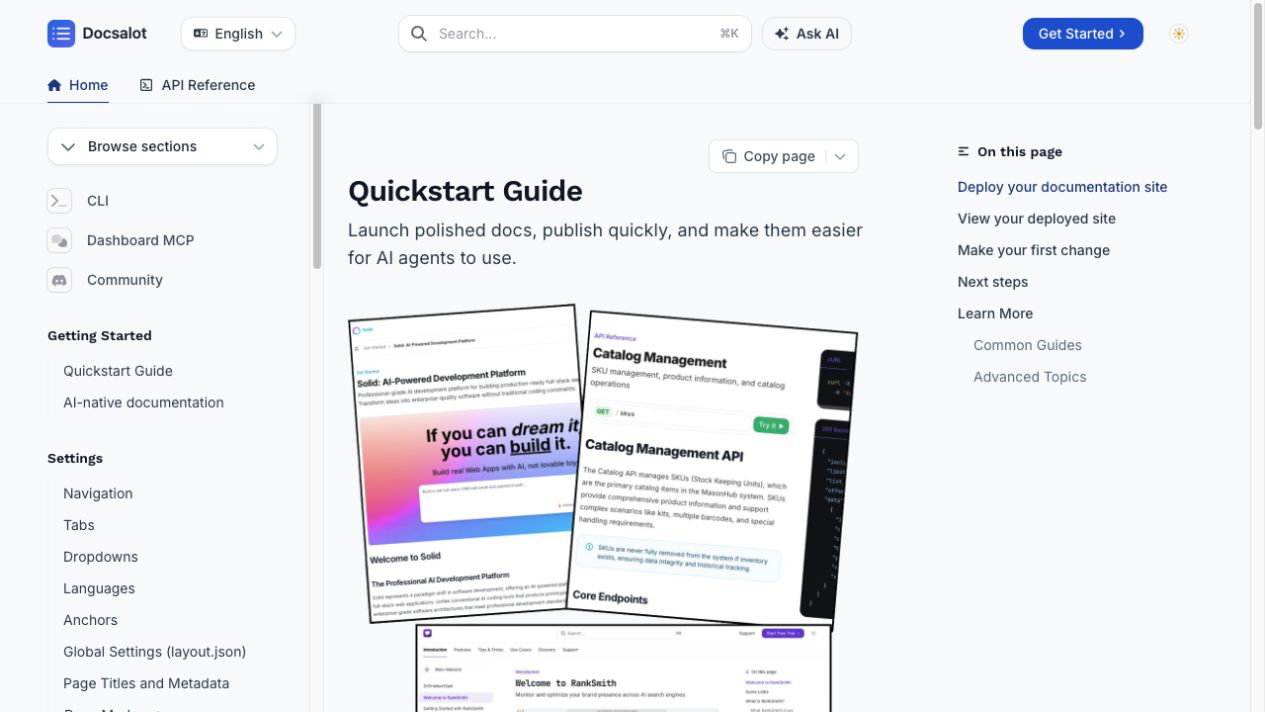
A current DocsAlot public-docs site. The product surface includes structured navigation, full-text search, Ask AI, and API-reference access without requiring a custom frontend build.
What To Look For In A Mintlify Alternative
Most teams are not just comparing page design. They are comparing the workflow around the docs.
Use this checklist:
- Developer docs: Can it publish clean product docs, guides, examples, and API docs?
- API docs: Does it support OpenAPI, API references, examples, and playground-style workflows?
- Git sync: Can engineers keep docs close to the codebase?
- Non-engineer editing: Can support, product, or success teams contribute without fighting Git?
- AI-readable docs: Does it support
llms.txt,skill.md, structured docs, and agent-friendly content? - MCP: Can the docs be exposed to agents through a hosted MCP server?
- Migration: Can you move existing docs without rebuilding the whole information architecture yourself?
- Pricing: Does the paid tier match the features you actually need?
The best Mintlify alternative is the one that matches the workflow you want after launch.
1. DocsAlot
Best for: teams that want the closest Mintlify alternative at a much lower monthly price.
DocsAlot is the direct Mintlify alternative in this list. It is built for teams that want developer docs, API docs, help-center content, Git sync, AI-readable outputs, hosted MCP, and migration support in one system.
The price gap is the simple reason to start here. DocsAlot Team is $99/month. Mintlify Pro is $450/month with annual billing or $540/month on monthly billing. If the practical feature surface is close enough for your team, that is the decision.
DocsAlot is especially useful when you want:
- hosted developer docs and API docs
- Git sync plus a CMS-style editing workflow
llms.txt,skill.md, and hosted MCP- help migrating messy existing docs
- AI-readable docs for agents and humans
- lower fixed pricing before the docs program is mature
Mintlify can still be the safer enterprise choice if your team already has a mature Git-native documentation process and the budget is not a concern. But if you searched for Mintlify alternative because the price or workflow feels heavy, DocsAlot vs Mintlify is the first page to read.
2. GitBook
Best for: collaborative docs and knowledge bases.
GitBook is a strong Mintlify alternative when the docs program involves engineers, PMs, support, customer success, and technical writers. Its visual editor and Git sync make it a better fit for mixed teams than a strict docs-as-code workflow.
GitBook is usually better when:
- many people need to edit docs
- public docs and internal knowledge are close together
- visual editing matters
- Git sync is useful but should not be the only workflow
- AI assistant and knowledge-platform features matter
The tradeoff is that GitBook can feel broader than a focused developer-docs platform. If you mostly want a lower-cost Mintlify replacement, DocsAlot is more direct. If you want a bigger collaborative knowledge product, GitBook belongs high on the shortlist.
Read next: Mintlify vs GitBook.
3. ReadMe
Best for: API portals and interactive API documentation.
ReadMe is a Mintlify alternative when your API is the product and the developer portal is the main surface. It is built around API references, guides, changelogs, developer dashboards, and interactive API workflows.
ReadMe is usually better when:
- the API portal matters more than broad product docs
- developers need to test endpoints inside docs
- API usage analytics matter
- changelogs and developer onboarding live together
- the docs buyer is really buying an API developer hub
The tradeoff is breadth. ReadMe is not always the cleanest answer for help-center docs, AI-readable documentation, migration support, or broader docs operations.
Read next: Mintlify vs ReadMe.
4. Fern
Best for: SDK-generation-centered API teams.
Fern is a strong alternative when docs are part of a bigger API infrastructure workflow. It can generate SDKs and API reference docs from specs like OpenAPI, AsyncAPI, OpenRPC, gRPC, and Fern Definition files.
Fern is usually better when:
- SDK generation is central
- API specs are the source of truth
- code samples and SDKs need to stay aligned
- API reference quality matters more than docs-site editing
- the docs workflow is part of an API lifecycle system
The tradeoff is that Fern is not trying to be a general documentation CMS. If you want the closest Mintlify-style docs publishing alternative, use DocsAlot. If SDK generation is the hard requirement, Fern is more relevant.
Read next: Mintlify vs Fern.
5. Fumadocs
Best for: Next.js teams that want open-source docs control.
Fumadocs is a good Mintlify alternative when the team wants a framework, not a hosted docs product. It makes sense if your docs are part of a Next.js app and engineering is comfortable owning the whole stack.
Fumadocs is usually better when:
- you want framework-level control
- docs live close to a Next.js product
- engineering owns design and deployment
- open-source flexibility matters
- you are willing to build agent-facing pieces yourself
The cost is maintenance. You own hosting, search, styling, IA, analytics, redirects, llms.txt, MCP, and update workflows.
Read next: Mintlify vs Fumadocs.
6. Docusaurus
Best for: mature open-source docs sites.
Docusaurus is the safest open-source framework alternative to Mintlify. It is mature, widely used, and flexible. For engineering-heavy teams that want full control, it can be the right answer.
Docusaurus is usually better when:
- open-source ownership matters
- React customization is a requirement
- docs are part of an engineering-managed site
- license cost matters more than engineering time
- you do not need a hosted editor or migration support
The tradeoff is that Docusaurus is not free in practice. The software is free. The engineering time is not.
Read next: Mintlify vs Docusaurus.
7. Redocly
Best for: OpenAPI governance and API reference quality.
Redocly is a Mintlify alternative when the API spec is the center of the documentation system. It is especially relevant for teams that care about OpenAPI linting, governance, catalogs, reference rendering, and spec quality.
Redocly is usually better when:
- OpenAPI governance matters
- API design standards matter
- API catalog workflows matter
- docs should enforce spec quality
- product docs are secondary to API docs
The tradeoff is that Redocly can be more API-platform than documentation platform. If your docs estate includes product guides, help docs, AI-readable outputs, and migration support, compare it carefully.
Read next: Mintlify vs Redocly.
8. Stoplight
Best for: API design and collaboration before docs are published.
Stoplight is useful when the team needs API design, mocking, governance, and documentation workflows together. It starts earlier in the API lifecycle than Mintlify.
Stoplight is usually better when:
- API design happens before implementation
- mocking and collaboration matter
- API style guides are important
- non-engineers participate in API design
- docs are one output of a larger API workflow
The tradeoff is focus. If the main job is a polished docs site, Stoplight may be heavier than needed.
Read next: Mintlify vs Stoplight.
Which Mintlify Alternative Should You Choose?
Here is the short answer:
- Choose DocsAlot if you want the closest feature-parity Mintlify alternative with lower pricing, AI-readable docs, Git sync, and MCP.
- Choose GitBook if you want collaborative docs and knowledge workflows.
- Choose ReadMe if your API portal is the product.
- Choose Fern if SDK generation is central.
- Choose Fumadocs or Docusaurus if you want open-source control.
- Choose Redocly or Stoplight if API governance and design are the core problems.
For most small teams searching for a cheaper Mintlify alternative, the cleanest first comparison is DocsAlot vs Mintlify.
FAQ
What is the best Mintlify alternative in 2026?
DocsAlot is the best direct Mintlify alternative if you want similar docs coverage, AI-readable docs, Git sync, MCP, and lower monthly pricing. GitBook is better if you want broader collaboration and knowledge-management workflows.
What is the cheapest Mintlify alternative?
Open-source tools like Docusaurus and Fumadocs are cheapest on software cost, but they require engineering ownership. DocsAlot is the most direct lower-cost hosted Mintlify alternative in this list at $99/month for the Team plan.
Is GitBook better than Mintlify?
GitBook is better when many people across product, support, and engineering need to contribute to docs. Mintlify is stronger when the team wants a polished Git-native developer-docs workflow.
Is Docusaurus a good Mintlify alternative?
Docusaurus is a good Mintlify alternative if you want open-source control and have engineering time for hosting, customization, search, redirects, analytics, and maintenance. It is not a managed Mintlify replacement.
Which Mintlify alternative is best for AI-readable docs?
DocsAlot is the most direct Mintlify alternative for AI-readable docs because it combines hosted docs, Git sync, llms.txt, skill.md, and hosted MCP. GitBook is also relevant if your workflow is more knowledge-platform oriented.